I had the absolute pleasure to be interviewed by Artem Siminenko, one of my former Expedia colleagues. In a wide range of topics around AI we focussed on what really matters today: execution over noise, de-risking over all-in and where AI adoption really matters!
Below is the article, which was also posted on Artem’s channel: Travel AI Playbook
Enjoy the read!
————————————————————————————————————————
The hard part of AI adoption starts when it touches the real travel stack: inventory, policies, servicing, payments, legacy systems and human exceptions.
That was the clearest takeaway from a conversation with Fritz Oberhummer, who has worked across Expedia, HRS, Intellias and Sabre and now he is the founder of Oberhummer Consulting, helping travel companies with AI workflow transformation, integrations, product and commercial strategy, and technical due diligence.
Fritz is quite optimistic about AI adoption in travel. He sees real potential in agentic workflows, smarter automation, better operations and more natural travel interfaces.
But Fritz’s warning is direct: too many companies still treat AI as if it will “solve all your problems” and as if “a chatbot is going to do everything for you.”
His point is that AI creates new responsibility. AI is not just another tool you switch on, he argued. Once a company brings AI into a workflow, it has to understand what AI can do, what are limitations, how it will be maintained, how it will be tested and how much it will cost to run.
That is where travel becomes different from simpler digital commerce. In e-commerce, the flow is often easy to understand: search, order, dispatch. Travel does not end at checkout. The traveler may change plans. The flight may be disrupted. The hotel policy may conflict with the airline policy. A booking may need to be modified, cancelled, refunded, reissued or serviced across multiple systems.
As Fritz put it: “You don’t shift goods. You shift people.”
That one line explains much of the AI challenge in travel. The next phase of travel AI will not be decided only by who builds the best conversational interface. It will be decided by those who understands the whole traveler journey and the technology that sits underneath it.
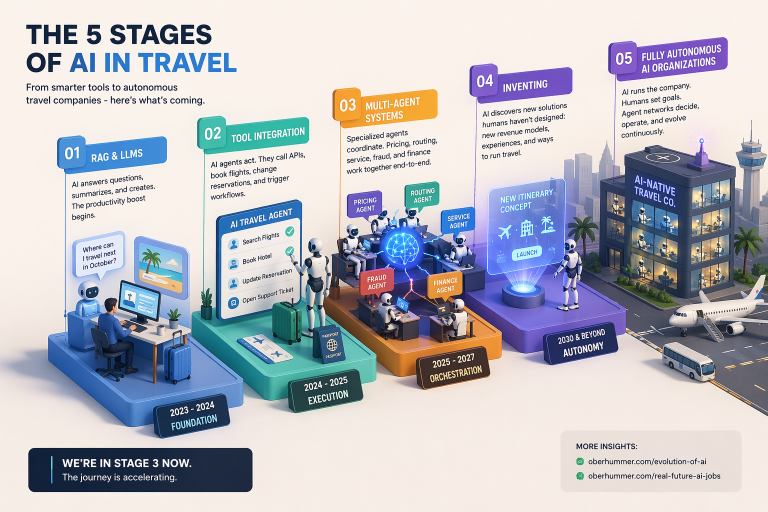
That view also fits what larger travel companies are learning in public. In a recent interview, Expedia CEO Ariane Gorin described how the company’s AI strategy had shifted away from one all-encompassing chatbot toward more specialized “point agents” for different stages of the journey. The lesson is not that end-to-end AI travel will never happen. It is that the practical work today is more specific: connect AI to the right workflow, at the right moment, with the right level of control.
AI scales weak systems
One of Fritz’s strongest warnings was that AI can super-scale business operations. That is useful if the underlying workflow is strong. It is dangerous if the workflow is weak.
“If you’ve built something bad before, AI will just scale it from bad to worse” he said.
This is a useful correction to much of the current AI discussion in travel. The industry often talks about AI as if it can sit above operational complexity and make it disappear. In production, AI usually has to work through that complexity.
A travel company still needs to know which problem it is solving. Without that clarity, companies risk producing what Fritz called “AI slop”: internal tools, pilots and experiments that look useful locally but never connect to a measurable business outcome.
That is already becoming an organizational problem. AI adoption is often moving from the bottom up. Employees can now build tools, prototypes and workflow shortcuts without waiting for large technology programs. That increases speed and experimentation, but the top of the organization is often still catching up.
“The bottom has gone into a sprint,” Fritz said.
Bottom-up adoption creates speed, but without top-down strategy it can also create duplication, weak governance and security risk, cost leakage and technical debt.
Senior leaders do not need to become AI engineers. But they do need to become more operator-like: close enough to the work to understand risk, workflow design, cost, testing and governance, and practical enough to decide what to stop, change or scale.
In Fritz’s view, modern travel companies need adaptable CIO leadership, stronger guardrails, cost monitoring, testing frameworks and crisis planning. They also need to ask a more uncomfortable question: can the company still operate if AI behaves unexpectedly, becomes too expensive, or a provider changes the rules?
AI strategy starts with pain, not tools
Which model should we use? Should we build a chatbot? Should we automate customer service? Should we launch an AI trip planner?
Fritz’s view is that companies should start earlier: with the business pain.
As he put it, the first question for executives is: “What keeps them awake at night? What is their biggest pain right now?”
Where is the traveler journey breaking? Which workflows are expensive, slow or inconsistent? Which problems are large enough to justify AI, and which are better solved through classic automation?
That distinction matters because AI is not free. Fritz asked a question that more travel companies should probably ask before launching another AI pilot: “Do we need to solve a problem that doesn’t need solving?”
Travel companies should not use AI where existing APIs, rules engines or deterministic automation already work well. The better use of AI may sit earlier in the workflow: cleaning messy inputs, structuring unstructured content, analysing where processes break, or preparing the system so that high-volume transactions can move more smoothly.
Fritz gave the example of policy normalization across flights, hotels and vacation rentals. A business traveler may need precise check-in instructions and cancellation rules. A family traveler may have different tolerance for flexibility. AI can help interpret messy policy data and serve the right information in the right context.
The same cost discipline is starting to show up in how major travel companies talk about AI internally. Booking.com Chief Business Officer James Waters recently described AI spend as something that has to be tracked against the value it creates, with product teams needing visibility into where tokens are spent and when cheaper models can be used for simpler tasks.
That is close to Fritz’s point: AI cost discipline is becoming a management problem, not just a technical one.
The hidden risk of one LLM provider
Another practical risk is dependency on a single LLM provider. Many companies are signing large agreements with one AI supplier. That may simplify procurement and rollout. But it also creates a new strategic dependency.
Model performance can change. Pricing can change. Access can change. Policies can change. A model that works well for one workflow may be weaker or more expensive for another. A company that builds too tightly around one provider may have limited room to adapt.
Fritz warned against companies tying themselves “completely to one company for a big deal,” whether that is Anthropic, OpenAI or Google.
His advice is not that every company needs to run every model for every use case. It is that companies should design AI workflow and governance, enabling flexibility and evaluation from the start.
“If you have only one model, you just have to trust your luck,” Fritz said.
Airlines are exposed
The sharpest industry-specific part of the conversation was Fritz’s view on airlines. He sees airlines as one of the least prepared parts of the travel industry for the AI shift. The reason is not lack of ambition. It is structure.
Airlines are operationally cautious for good reasons. Their core systems are tied to safety, reliability and continuity. “The beating heart of any airline company is a passenger service system,” Fritz said.
The PSS supports booking, ticketing, check-in and many other critical functions. The problem is that many of those cores were not designed for the kind of traffic and automation pressure that AI agents may create.
If AI assistants dramatically increase shopping, comparison, servicing and modification requests, airline infrastructure will face more load. This is where the GDS role becomes more interesting.
For years, airlines have tried to reduce GDS dependency through direct distribution and NDC. That may still make commercial sense in many cases. But the GDS also absorbed traffic, complexity and operational problems. When airlines take more direct control, they inherit more of that burden.
Recent market signals point in the same direction. Amadeus has been discussing the “infinite search” problem: AI agents can generate far more shopping requests than human users, creating pressure on systems built for older search patterns. In one reported example, an AI coding agent pulled more than 880,000 fare options from Etihad for a single trip, while Amadeus travel president Decius Valmorbida pointed to scale as a core advantage, saying Amadeus systems handle around 150,000 transactions per second.
AI may make the GDS more important, not less
GDS role might go beyond helping airlines. If the user interface moves from search boxes to AI agents, the need for reliable, structured, bookable content will increase.
In that world, the GDS does not need to own the customer-facing interface to remain important. It can remain what it has often been: infrastructure.
“You always need base infrastructure that everybody can attach to,” Fritz said.
He compared the GDS to a rail network: not always the most flexible layer, but still a base infrastructure that lets things move at scale.
Sabre is approaching the same problem from the infrastructure side. In June, the company said its MCP Server is being used to let autonomous AI agents interact directly with travel workflows, including post-booking processes such as ticket reissues, dynamic exchanges and servicing updates.
That matters because those are exactly the kinds of multi-step processes that separate real agentic travel from a better search box.
Conversational search is not agentic booking
We spoke about the new wave of AI travel startups. A conversational search result is not the same as agentic booking. If AI converts a natural-language request into search results and then hands the traveler back to a standard OTA checkout, Fritz called that “a hybrid.” It may be useful. It may improve discovery. But it is not true agentic booking.
In Fritz’s view, agentic booking should go further. It should handle “the searching, the booking and the servicing all in the same channel.”
That is a useful test for AI travel products. Can the system only understand the traveler, or can it also fulfill what it promises? Many tools can improve inspiration and search. Fewer have solved booking, modification, servicing, policy logic, payment, supplier connectivity and human escalation.
The human warning
Fritz’s final warning was not about models. It was about people.
Many companies are looking at AI and seeing a path to large staff reductions. Some may be right to expect efficiency gains. But he cautioned against cutting people before redesigning the work.
“Before you go into redundancies, think carefully about whether your reorg is also reorganizing your projects,” he said. If companies remove staff but keep the same projects, the same systems and the same complexity, they may simply lose the knowledge needed to manage the transition.
That is a serious risk in travel. Much of the industry still depends on experienced people who understand exceptions, supplier behavior, legacy systems, operational workarounds and customer edge cases. AI can augment some of that knowledge. It can automate parts of the workflow. But once institutional knowledge is gone, it is hard to rebuild.
The better question for executives is not: how many people can AI replace?
It is: which work should still exist, which projects should stop, which workflows should be redesigned, and where does human judgment remain necessary?
That may be the real AI operating-model challenge. AI may change the interface of travel. But it will not remove the operational reality underneath.
Because in travel, you do not shift goods. You shift people.