 One thought I keep having lately: the travel industry does not need more AI hype. No more glitzy slide decks, big news statements, or overpromised features that no one really knows what they deliver — let alone what those features will actually achieve in concert.
What I think it needs is a clearer view of what is actually changing, what comes next, and where companies (and their executives) should place their bets now.
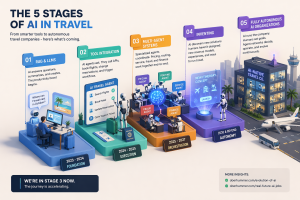
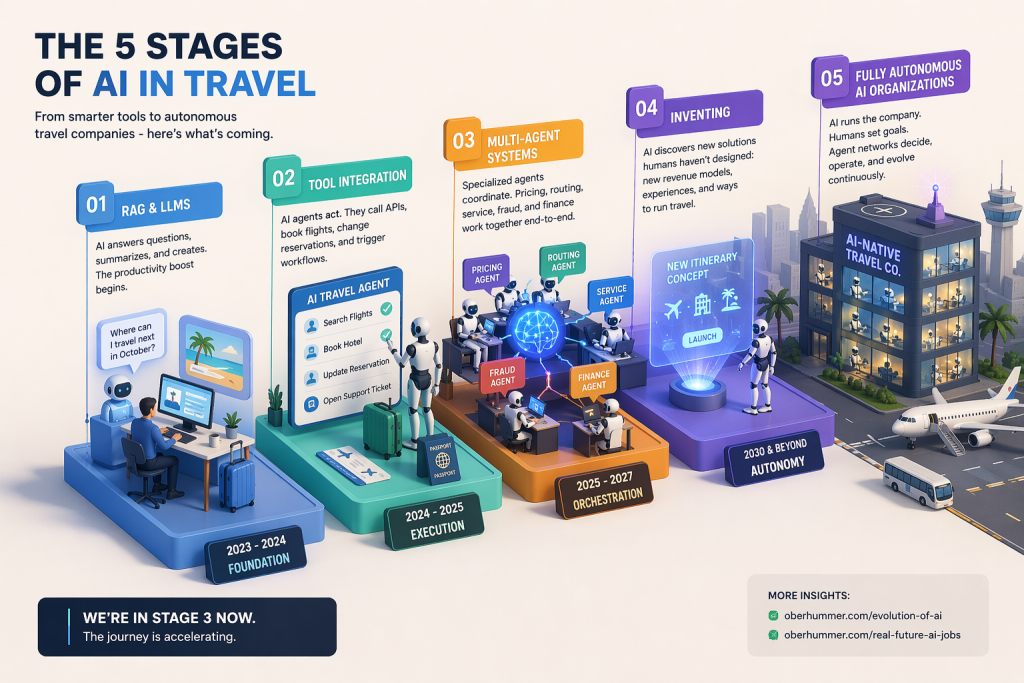
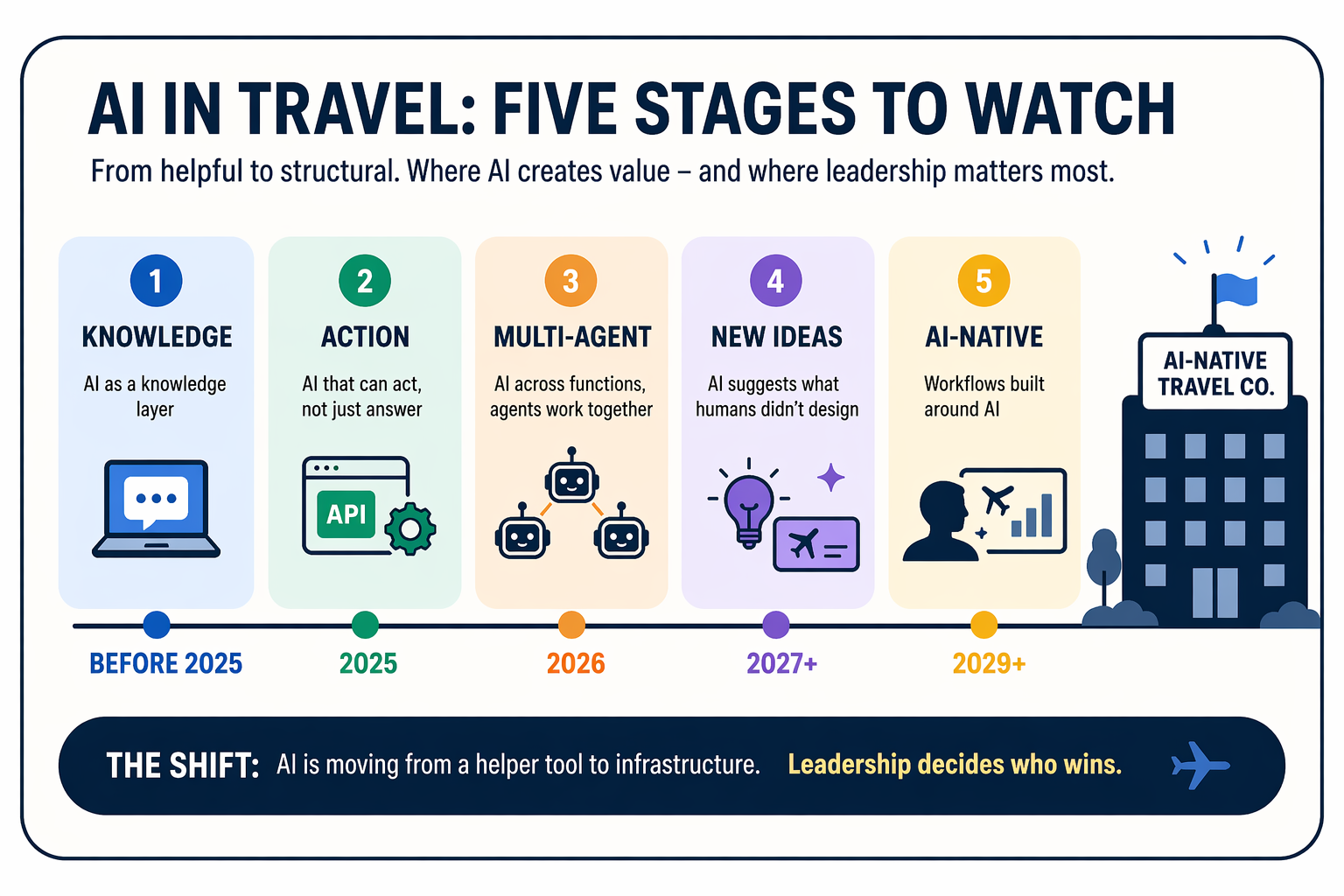
My opinion, based on conversations and common consensus, is that AI adoption in travel is unfolding in five stages.
These are not neat evolutionary steps where one phase simply follows the next, and not every company will move through them at the same speed — especially with the extraordinary developments going on this year since Claude Code was released.
But what I want to offer is a practical framework: one that shows the core theory behind each stage, how value is being created, where new risks emerge, and how operating models might change.
Most importantly, this is not another “we will all be replaced by AI soon” post, but rather a pragmatic guide to the state of things: understanding where AI goes beyond being a helper tool and starts becoming structurally central — and, most importantly, where leadership still matters most.
Before 2025: RAG and LLMs (AI as a knowledge layer)
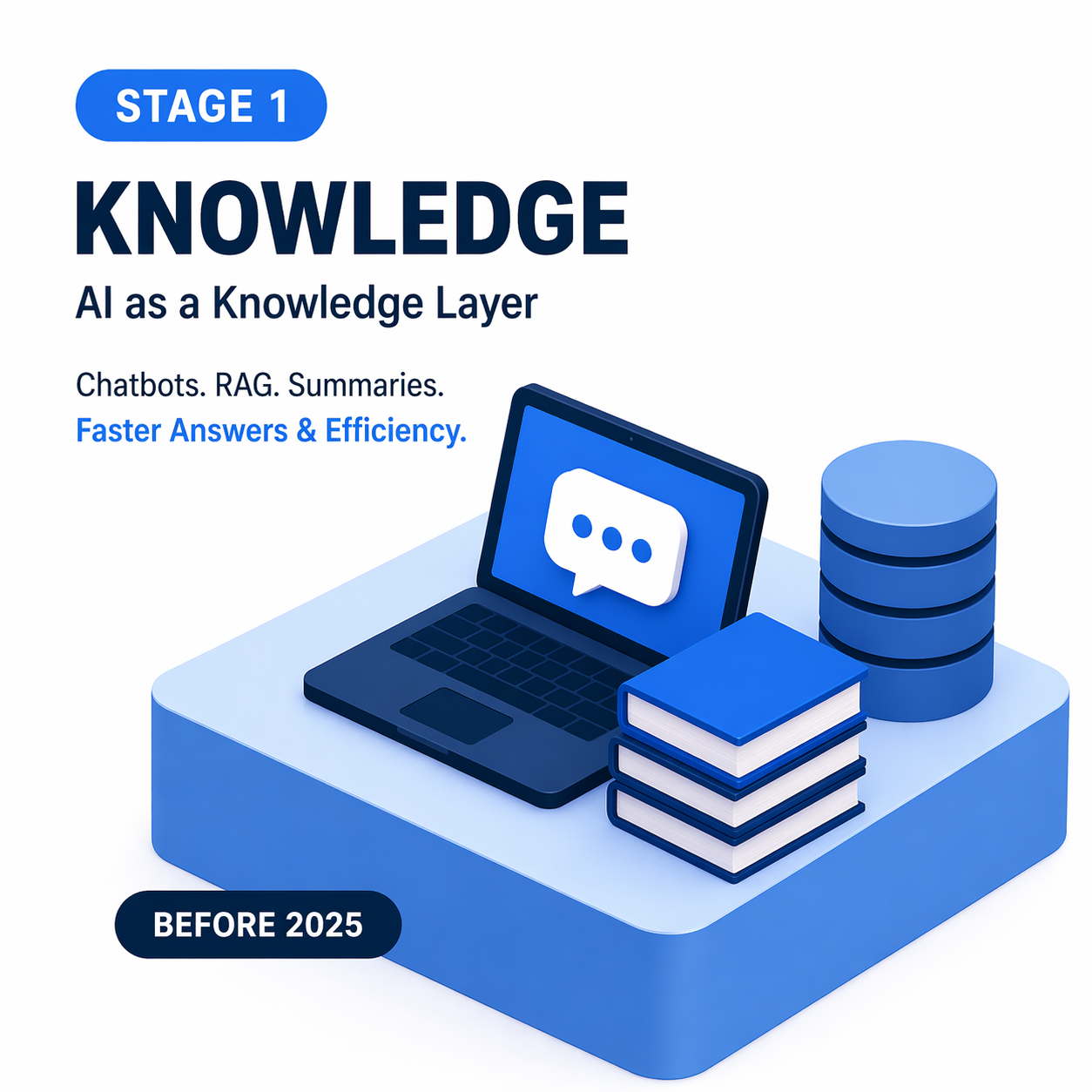 This is where we all pretty much started from 2022 onwards: chatbots, knowledge assistants, document summarization from file repositories and intranets, internal copilots, text content generation, and faster customer FAQ answers.
In the industry, this stage is basically business as usual, where almost all companies have adopted this in some form or another. It helps service agents retrieve policy information faster, supports sales teams with better answers, improves content operations, and reduces friction in internal workflows. But the important thing to understand is this: Stage 1 is still more about efficiency gains in man-hours than about plannable revenue.
The key mistake here is that people have treated this as a “magic wand” solution that, in their opinion, firmly puts them aboard the AI train.
But a chatbot on a website is not a strategy on its own. If the underlying document and data sources are disorganized, disconnected, or outdated, the AI will simply surface those problems faster — by producing hallucinations of the worst kind.
Thus, for travel companies, Stage 1 really is, or was, a data and knowledge discipline test. Whoever organizes product content, support policies, operational procedures, and supplier information best will get more value from AI first. And whoever does not organize this activity is already falling behind in the race for the next stages.
2025: AI that can act, not just answer (tool integration)
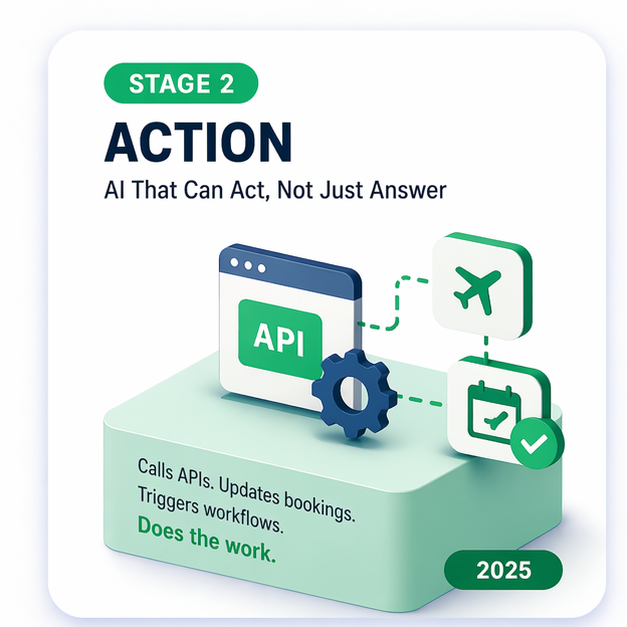
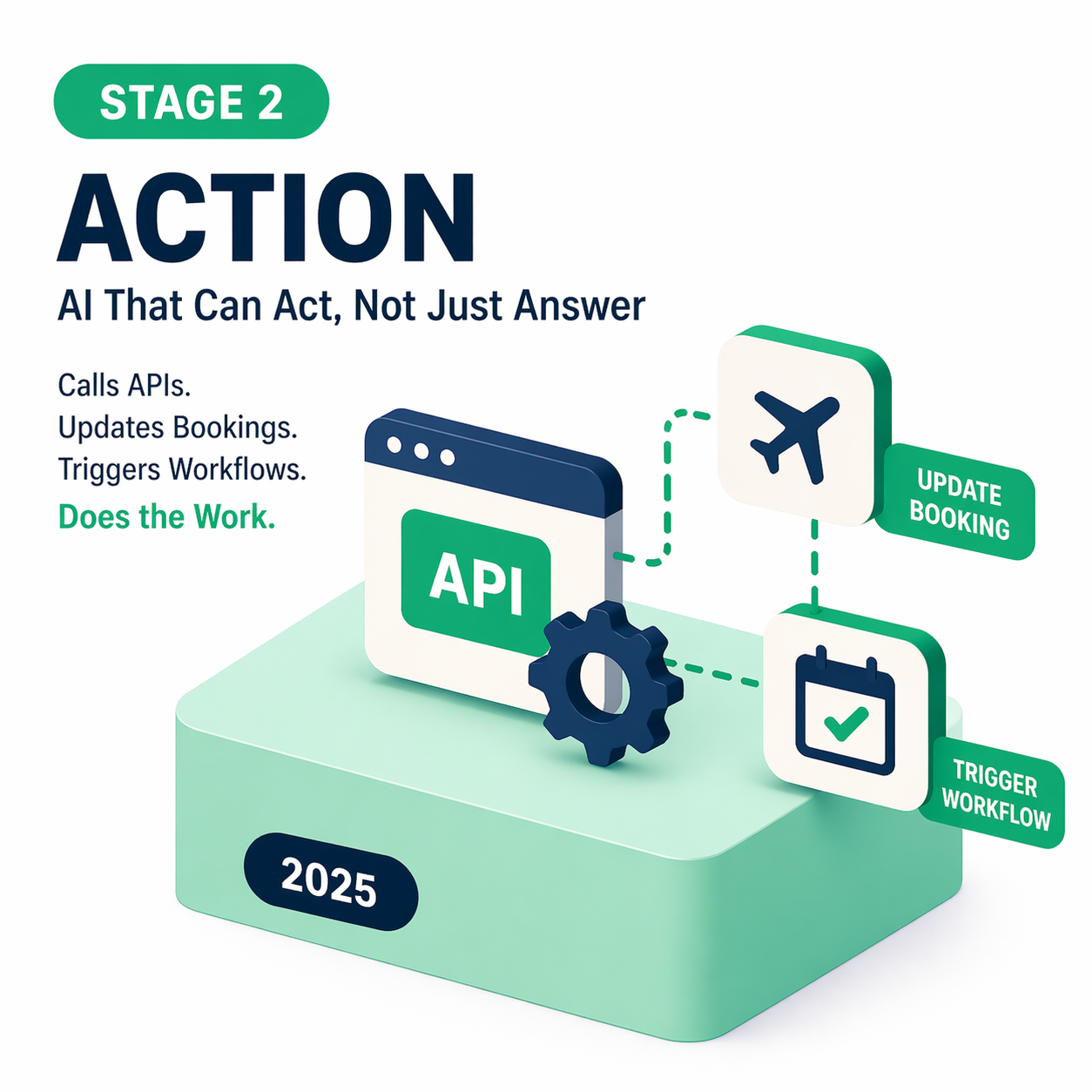 The second stage started when AI was connected to systems and tools at scale last year. Its newly created ability to act, watch, analyze, and improve was a massive step forward from pure knowledge management. It is the application of that knowledge that starts to make all the difference: AI can call APIs, pull live inventory, open tickets, change reservations, trigger workflows, and interact with operational systems.
This is certainly where AI finally becomes much more relevant to travel — an industry full of fragmented systems, repetitive manual work by human agents, and service processes that span multiple tools and entry points.
The current thinking I hear from C-level leaders mainly focuses on disruption handling, rebooking, refund workflows, ancillary upsell logic, loyalty servicing, and internal operations support. Of lesser importance are fancy things like “curated travel search,” which looks great on the surface but so far often seems more likely to incur cost than generate revenue because of excessive token and API usage.
For executives, this is the point where systems architecture starts to matter more than prompts. The question is no longer, “Can we use AI in our business?” but rather, “Which parts of our travel workflows are structured enough to let AI do useful work safely?”
2026: AI across functions, not just tasks (multi-agent systems)
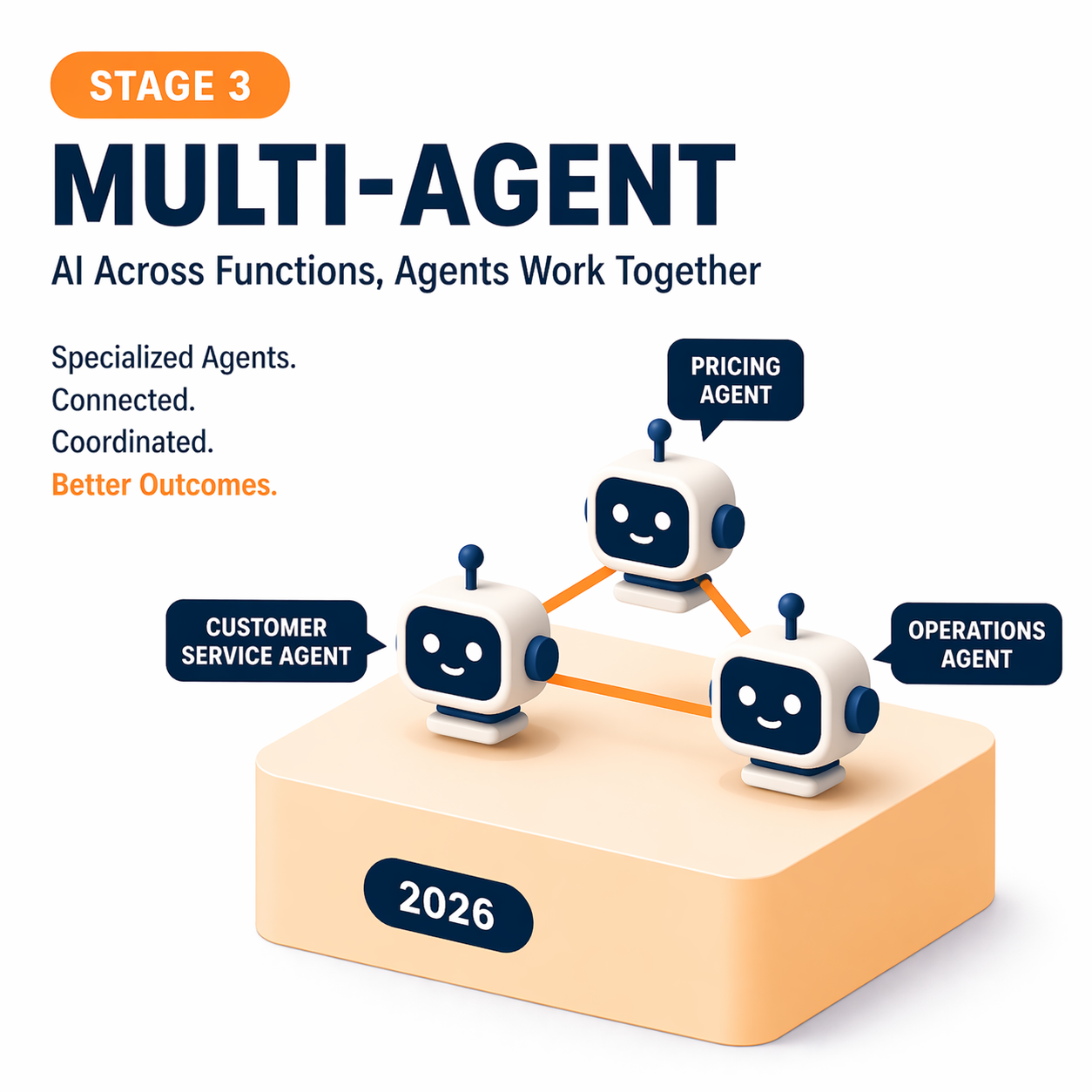 This is where things get much more interesting, and in truth it really started this year when Anthropic released its game-changing Claude Co-work model.
The principle was already there: instead of one model doing one task, multiple specialized agents begin to coordinate. One agent handles customer communication, another pricing, another fraud checks, another servicing, another finance or fulfillment. An orchestration layer connects them and adds further sanity checks — also often just another control AI model, a principle I already highlighted some years ago in one of my posts: The Evolution of AI: Hoplites, Centurions and Napoleon — to keep quality measurable.
Travel is naturally suited to this because the traveler’s journey has so many parts: discovery, search, pricing, payment, confirmation, servicing, disruption, and post-trip follow-up. The same is true on the supply side: contracting, availability, distribution, revenue management, customer support, and settlement.
Once AI starts operating across those chains in a truly interconnected manner, companies will see a very different kind of leverage. Not just faster work, but better cross-functional execution — creating massive productivity and incremental revenue opportunities.
This is also the stage where leadership teams need to resist a common temptation: automating broken processes. It reminds me a bit of lifting outdated software systems into the cloud and then being surprised when results do not really improve after all, creating plenty of disappointment in C-suite leadership — quelle surprise!
As fast as AI can spool up productivity, it can also spool up broken processes, weak and outdated connectivity, or non-scalable software — and send the travel-tech cart right off the cliff.
2027?: AI as a source of new ideas, not just automation
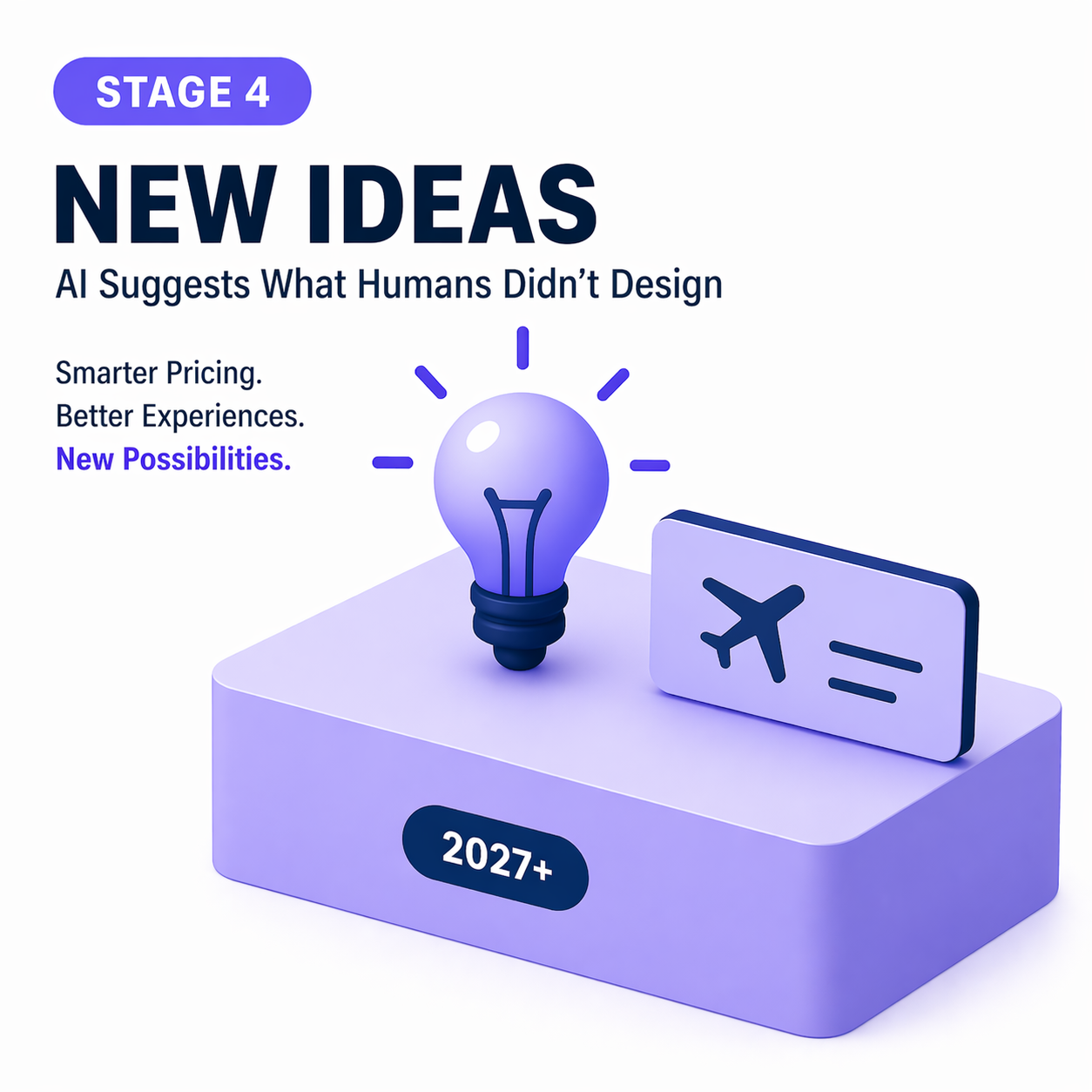 The fourth stage will come when AI becomes more than an optimizer. It starts to suggest approaches that humans did not explicitly design. I only heard today, for instance, how Anthropic’s latest model, Mythos, surprised its creators with creative process design that was not part of the specifications.
In travel, this could show up in pricing logic, merchandising, schedule design, disruption recovery, personalization, itinerary construction, or customer experience design. Not just “do the same thing faster,” but “discover a better way to do it.”
This matters because travel is full of unexpected constraints: limited supply, perishable inventory, complex consumer intent, narrow margins, and high service expectations. Anyone working with NDC airline inventory and trying to cache it will know what I mean. Put on top of that a world where large-scale disruption — wars, climate events, strikes, and more — has become the new normal, and this kind of AI is well suited to such an environment.
But this is also where human judgment becomes more — not less — important. Novel suggestions by AI are only valuable if they are commercially sound, operationally workable, and aligned with brand and customer trust. Humans will not be replaced easily here, because the wrong large-scale decisions can spell real trouble.
Executives should see Stage 4 as a true test-bed stage. Not a reason to switch on autopilot and lean back, but a reason to build environments where AI can propose, simulate, and stress-test new ideas before they reach production. Staging environments then really become stand-up acting areas for AI models.
2029?: AI-native operating models (organizations built around AI workflows)
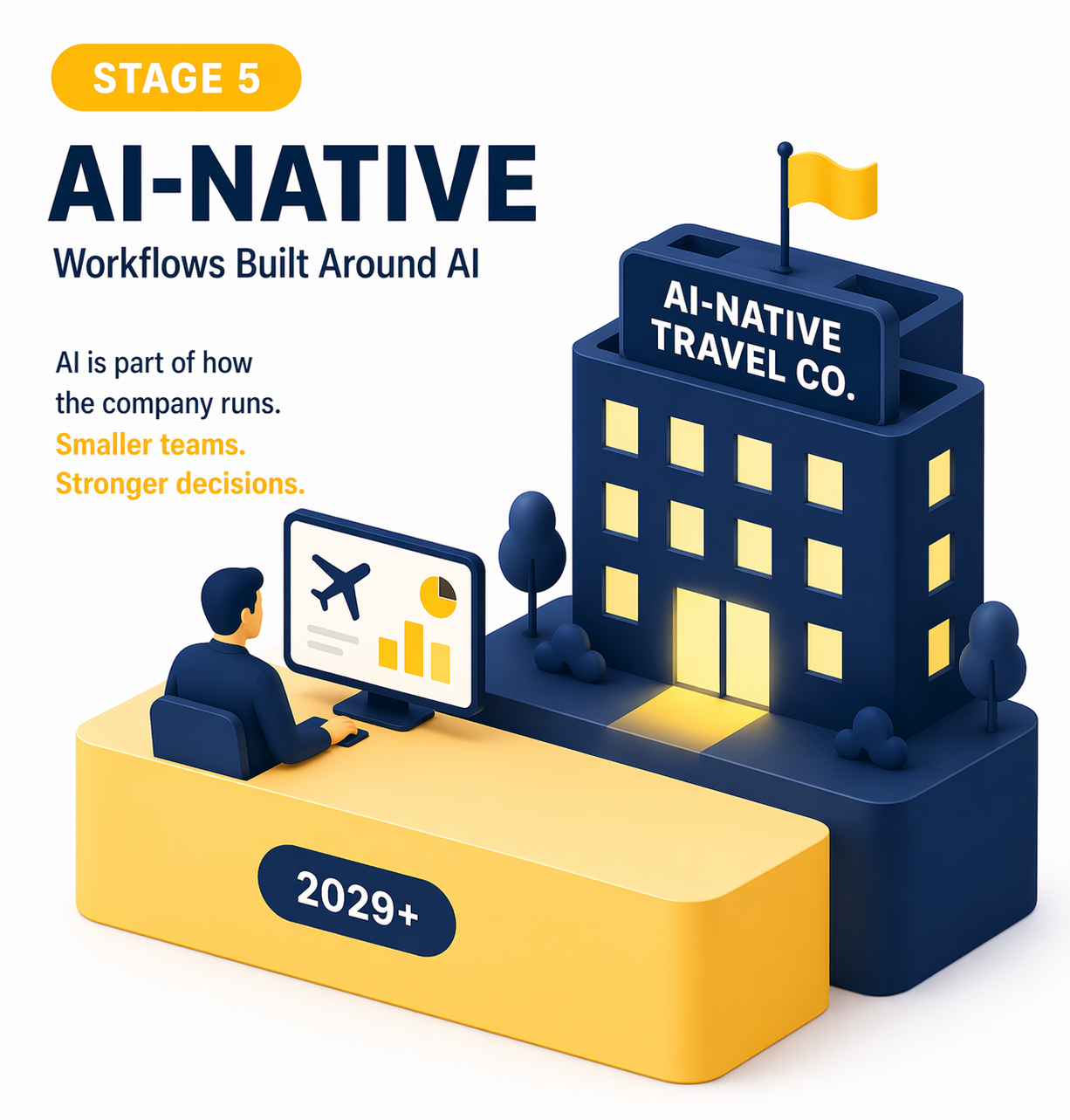 The final stage is likely not really about “fully autonomous companies.” That framing is too dramatic and, for most practical discussions, not all that useful — unless the AIs can also lift your luggage on and off the belt.
A better way to think about it is this: the operating model itself becomes AI-native.
That means workflows are designed with AI participation from the start. Teams become smaller in some areas, more specialized in others, and human roles shift toward judgment, escalation, design, governance, supplier relationships, and exception handling. AI no longer sits at the edges of the business. It sits inside the way the business runs, as a true and accepted companion.
For travel, this could reshape customer service, revenue operations, supply management, product operations, and internal decision-making. It may also change where value sits in the industry. Companies with strong data, strong workflow design, and strong trust architectures will benefit much more than companies that merely add AI as a thin layer on top of legacy complexity.
And by all means, equity valuation and stock-market narratives may increasingly be influenced by AI models evaluating the “AI operating system” of travel companies. Mergers and acquisitions, too, could accelerate dramatically if integration, convergence, and process alignment become far more automated than they are today. Failed mergers may not disappear entirely, but the nature of post-merger integration could change substantially.
Again, this stage is not about removing humans. It is about redesigning work so humans focus where human judgment matters most.
Beyond 2030
I naturally have some thoughts about this… but it is too early yet to make proper predictions. Yes, sooner or later we might have to face a kind of “singularity” moment in travel, where AI takes on an altogether different role in human society and, subsequently, history. But to put it in the words of a great manager I once had: “Let’s cross that bridge once we get there, shall we…?”
What all of this means for travel leaders now
Some things, I think, are already clear:
First, most travel companies should stop thinking about AI as purely a feature discussion. This is increasingly an operating model discussion, and choices need to be made, strategies need to be set, and companies need both flexibility and direction if they want to move forward through this new age.
Second, the winners will likely not be the loudest AI marketers screaming from the rooftops about how outstanding their features are. They will be the companies that can demonstrate cleaner data, better workflows, designated ownership, and a more realistic understanding of where AI helps and where it needs guardrails — especially around cost, as many companies will quickly experience a “double-burn” effect: cloud cost and token cost.
Third, trust will become even more important, and it will need to be demonstrated both to humans and to AI evaluation models simultaneously. Travel is high-stakes, emotional, fragmented, and full of exceptions — with moments of quiet and moments of total frenzy. Anyone travelling experiences that themselves, after all. AI that makes the experience more reliable, transparent, and useful will create value through outstanding execution. AI that adds opacity or removes accountability will destroy it.
And finally, executives should not try a “jump to Stage 5 so we can get ahead of the others.” That will likely end in massive failure.
The practical path is still the right one:
- first of all, get your knowledge layer right (clean your data, update your setups, and run logic tests — lots of them),
- identify workflows where AI can act safely (where guardrails are easy to implement and test),
- connect systems carefully (service-oriented architecture has been around for a while, no?),
- redesign broken processes before automating them (avoiding super-hallucinations),
- and build internal capability around governance, evolution, monitoring, and human escalation.
AI in travel is clearly now moving from being a feature, or a glorified assistant, to becoming infrastructure. That is the shift executives need to pay attention to.
The opportunity is real, and many people I have recently spoken to are already taking strides simply by following the above model. But ultimately, the real question is whether companies today are already starting to treat this as the beginning of a new operating model.
What are your thoughts? Let me know here or in the LinkedIn post
Are you interested in Travel Technology consulting for your company?
Just contact me below and let´s arrange an intro call to see what I could do for you!